
Ten Principles for Inclusive and Intersectional Philanthropy
10 Principles for Inclusive and Intersectional Philanthropy, serves as a framework for redefining how power, resources, and trust are distributed within the funding ecosystem. Built upon the insights and lived experiences of leaders with disabilities, funders and philanthropists funding disability, the document was produced after a Funder Roundtable organised by Rising Flame and Mariwala Health Initiative at the International Purple Fest, 2025. The framework advocates for a radical shift towards centering disability as an essential element of justice, equity, and human dignity. By moving toward long-term movement-building and embedded accessibility, these ten principles provide funders and practitioners with a definitive guide to fostering a more equitable and disability-affirming future.
Read in pdf.
Visions of Power and Possibility: Building Our Future Together
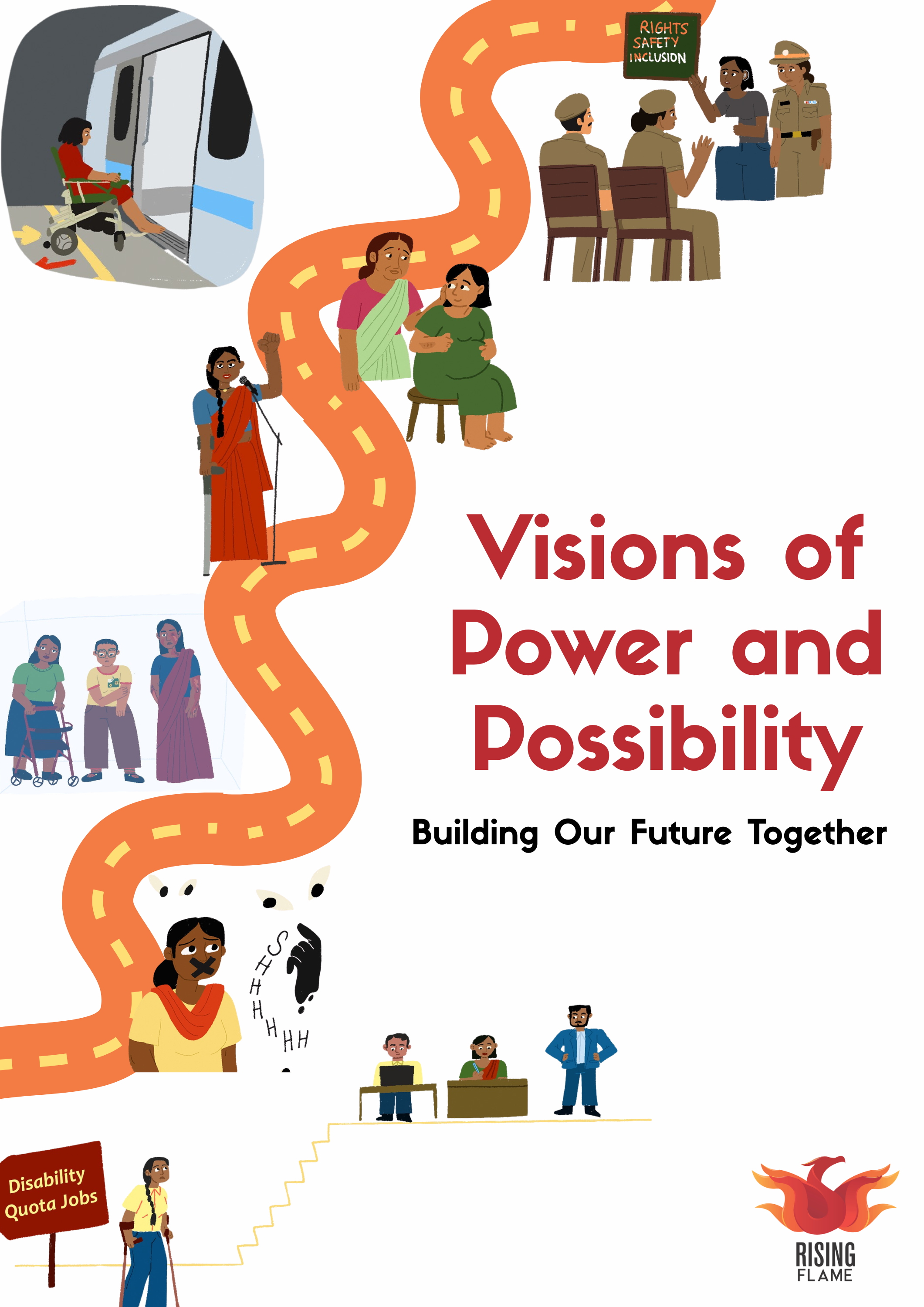
Visions of Power and Possibility is a collective manifesto that charts a transformative five-year roadmap for women with disabilities. Emerging from a national dialogue of 40 women with disabilities leaders at International Purple Fest, the document assesses current systemic gaps across 5 thematic areas accessibility and inclusion; education; employment and livelihoods; and health including mental health, maternal health and reproductive justice, and violence and access to justice. It centers the political priorities and leadership of women with disabilities as a community who are often sidelined in both disability and women’s rights spaces. It is a document that moves our voices from the margins to the centre, laying out today’s challenges while imagining a more inclusive future.
Benchmarking Disability Inclusion: 10 years of SDG implementation in India

2025 signifies the 10 year completion of the Sustainable Development Goals. For us, it was critical to evaluate where India had progressed in these 10 years with regards to disability inclusion. Keeping in mind that several goals and targets specifically mention disability and that the mantra of SDGs is leaving no one behind, we conducted primary and secondary research on the progress of disability rights in the country within the framework of SDGs. This enabled us to draft a comprehensive report on disability inclusion vis-a-vis current situation, the gaps and challenges, the progress and recommendations.
This report is based on multi channel primary data collection in 2025, secondary and indepth review and research, and enhanced with expert reviewers. this report is published at the end of a year long intensive process.
Insights: A mental health collection
People with disabilities, chronic illnesses and mental health conditions encounter ableism in almost every facet of our lives — education, work, public spaces, romance, and even in our relationship with ourselves. This cumulative toll leaves an indelible mark on our mental health. The expectation to ‘overcome challenges’, successfully perform bodily and economic autonomy, attain romantic ‘success’, and check off the numerous milestones of adulthood further fractures our sense of self. Equally underrepresented are the ways disabled people survive and thrive despite our environments. We seek to create language, experiences and relationships that exist both within and outside non-disabled ways of being in the world. Insights is a collection of personal essays, comics, reported stories or audio piece that sheds light on the mental health experiences of people with disabilities and chronic illnesses in India. Read the collection here.
Goa Disability Report - 2024
We collaborated with Mariwala Health Initiative on the 'Goa Disability Report' to bring a shift in implementations of disability rights-focused policies and the Rights of Persons with Disabilities (RPwD) Act, 2016.
Grounded in a rights-based and intersectional approach, the report situates disability within broader structures of marginalisation, recognising how access to education, healthcare, employment, social security, and skill development shapes participation in society. The report draws on extensive consultations conducted in June 2024 led by us with deep engagement with persons with disabilities, caregivers, civil society organisations, and government stakeholders across Goa. The recommendations in the report are a result of meticulous research, stakeholder consultations, and expert reviews.
The report also outlines a framework to support the state government in enhancing service delivery and ensuring effective compliance with the RPwD Act. You can read the full report here.
Connections: Unpacking the complexities of disability and relationships in therapeutic conversations

Connections is our third self-learning mental health manual created by Rising Flame with support from Mariwala Health Initiative to respond to these concerns, realities of persons with disabilities and focus on the learning and unlearning needed by mental health workers. The manual published in March 2025 explores disability and relationships through the experiences of persons with disabilities. The manual also offers therapeutic exercises based on narrative practices to help individuals reframe their relationship experiences and overcome limiting beliefs. Ultimately, it advocates for a deeper understanding of diverse needs and the richness disabled individuals bring to all relationships.
Read here.
Asia Pacific Declaration of Women and Girls with Disabilities

Collaboration, consultation, and drafting for this declaration was facilitated by Rising Flame, India where an open call for inputs was released and circulated through multiple media across Asia and the Pacific and globally. The inputs received were duly integrated into the declaration along with recent consultative reports from the region. After the declaration was circulated, Rising Flame incorporated a second round of feedback and inputs into the declaration, and facilitated a mass outreach for endorsements through multiple channels – emails, listserves, WhatsApp and WhatsApp groups, social media.
Rising Flame recognises and reiterates the value of the Beijing Declaration and Platform for Action in catalysing inclusive organising and action among women from diverse social contexts and across generations and abilities to advance the position of all women and girls. With 35 contributors and 240+ endorsements the declaration can be downloaded here Doc | Pdf
And They Lived...Ever After

Meet a deaf Snow White, a wheelchair-using Rapunzel, a neurodivergent Ugly Duckling. In a world where fairy tales usually demonise characters who live with disability, these and other fairy-tale characters challenge our understanding of the people around us. The authors of this collection seek to retell classic stories by weaving in their own everyday experiences-the struggles, joys and frustrations that may not be known to the non-disabled.
And They Lived ... Ever After grew out of a programme organised by Rising Flame, an award-winning non-profit that seeks to build an inclusive world in which diverse bodies, minds and voices thrive with dignity and live free of discrimination, abuse and violence. This book is every bit as enchanting as it is important. Read here.
Holding Space: Part 2

The experiences of persons with disabilities are not homogenous. Depending on the disability itself, whether the disability is visible or invisible, and depending on the intersections of other marginalisations whether it's caste, religion, gender or sexuality, people experience their disability differently and society perceives them differently. The part 2 of the self learning manual Holding Space focuses on these experience and helps address these challenges and ensures that support is affirmative, sensitive and inclusive.
Read here.
Purple People

Rising Flame conceptualised and curated the first-ever, unique gender track at the international Purple Fest called Purple People, from January 11 to 13, 2024 at Kala Academy Goa to spotlight the challenges faced by women, gender-marginalised persons and all people with disabilities, and their specific life experiences. Under Purple People, we organised panels, masterclasses, and a reading session covering work and leadership, accessibility, mobility, technology, sexuality, disabled parenting, climate change, consent, and more. This booklet aims to capture the diverse conversations that took place then and bring it all together. These illustrations and pieces will challenge stigma to show women and persons with disabilities as full human beings with lives and careers, with ambition and love, as parents and caregivers. Read here.
Disability, Equity, Justice White Paper, Civil 20 India, 2023

To capture the full data from the consultations with and participation of over 2,500 persons with and without disabilities, nonprofit organisations, Organisations of Persons with Disabilities, disability rights experts, officers from multilaterals and disability rights allies from across 35 countries, we drafted the white paper as an extension of the policy brief. It comprises of voices that were captured through in person and virtual consultations/ round tables and conference but also through online direct channels opened up for receiving recommendations and suggestions.
Read here.
Holding Space: Part 1

Holding Space is the first in a series that we will be working on to expand the understanding of mental health practitioners on disability experiences and ableism’s demands on disabled people’s lives, and its effects on their mental health. The manual highlights the need for mental health professionals to specifically learn about this and bring these learnings and 'unlearnings' into their mental health practice supporting disabled people.
Read here.
Dil Vil Pyaar Vyaar

Dil Vil Pyaar Vyaar is a Rising Flame campaign organised around valentine's day in 2020 and 2021. It is a series of essays on love, intimacy, relationships and disability in collaboration with mainstream spaces. Personal stories about dating, crushes, rejection, heartbreak, expectations from partners or of partners and building own worlds of romance and pleasures. Dil Vil Pyaar Vyaar is an effort to amplify voices of disabled women; narratives on love that seldom are seen in mainstream discussions on romance.
To download the book with these stories, click here.
Neglected and Forgotten

We conducted a research study in collaboration with Sightsavers to respond to the urgent needs of women with disabilities in India during the COVID-19 pandemic. The research captured and amplified voices and narratives of women with disabilities and to make strong recommendations to ensure inclusion of women with disabilities in social, legal, policy and systemic responses.
We conducted online and telephonic research consultations in May 2020. A total of 82 women with disabilities and 12 experts across 19 states and nine self-identified disability groups participated in the research.
Read the full research here.
From The Shadows To The Centre

From the Shadows to the Centre is a Rising Flame campaign which was run as part of 16 Days global campaign to End Gender Based Violence in 2020. Our campaign features 7 personal essays of women with disabilities, speaking up about the sexual harassment they have faced and saying #MeToo.
Read their stories as a collection here.