
In collaboration with the Social Security and Empowerment of Persons with Disabilities Department (SSEPD) Odisha, UNFPA Odisha and People’s Rural Education Movement (PREM), Rising Flame has conceptualised and built life skills education curriculum for students in Classes 5 to 7 and Classes 8 to 10 in Deaf Schools and Blind schools of Odisha. This curriculum bridges the knowledge and information gaps in these special schools and provides crucial resources for adolescents with disabilities to develop their sense of self and build leaders of tomorrow.
This programme is part of a government collaboration and is designed for special schools with more than 5000 children with disabilities in the state.
The life skills education curriculum was built keeping teachers, educators and resource persons working with students with disabilities in mind. It centers the crucial early adolescent and middle adolescent years. The manuals aim to create a safe space where learners are encouraged to communicate, understand and participate, without being restricted. The curriculum for adolescents with disabilities considers challenges unique to specific experiences of disability and works towards building their sense of self, confidence in relationships, social connections and community engagement. Additionally, the curriculum focuses on sensitive and challenging subjects such as disability, discrimination, and sexual and reproductive health (SRH) themes, such as adolescence and puberty, privacy, gender stereotypes, safety, and abuse, addresses the stigma and taboo associated with these topics.
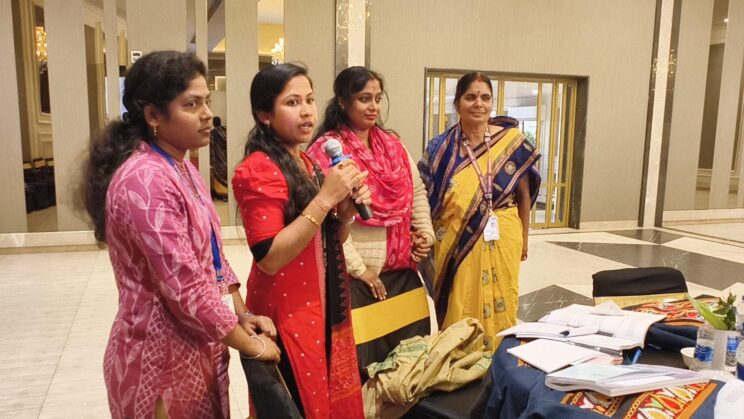
The Contextualised Life Skills Education Curriculum training based on the curriculum was conducted by the Rising Flame team from December 15 to 19, 2025 in Bhubaneswar, Odisha. A total of 59 teachers were trained who were identified as master trainers responsible for implementing the curriculum and orienting other teachers at their respective schools.
Blind schools special educators training, December 15 – 17, 2025
We conducted a training for 24 special educators across19 districts in Odisha, including 13 women and 11 men, each from a different school. Three of the participants were blind. The group represented a diverse age range, between 26 and 59.
The training was facilitated by the Rising Flame team—Nidhi Goyal, Founder and Executive Director; Srinidhi Raghavan, Programmes Lead; and Anusuya Jena, Translator—supported by Fizza Juddy, Co-ordinator – Social Media & Communications. Sessions were conducted in Hindi and Odia.
Over two and a half days, participants engaged deeply with the curriculum through group activities, roleplay, real-life case studies, and video-based discussions. The sessions explored topics such as understanding disability and the importance of role models for disabled children; feelings and empathy; bodily changes during puberty; sex, gender, and sexuality; consent and relationships; child sexual abuse; decision-making and critical thinking; and dreaming and making a difference. All discussions and activities were rooted in the lived realities of blind children, ensuring the content was relevant, accessible, and grounded in their experiences.
The participants from blind schools shared overwhelmingly positive feedback on the training conducted on the Rising Flame curriculum. The programme was widely appreciated for being timely, relevant, and deeply impactful for both educators and children.


Deaf schools special educators training, December 17 – 19, 2025
We conducted a training for 35 special educators across 17 districts in Odisha, including 14 women and 20 men, each from a different school. They represented a diverse age range of 27 to 59 years.
The training was facilitated by the Rising Flame team—Srinidhi Raghavan, Programmes Lead; Prachi Arora, Special educator and Indian Sign Language (ISL) Interpreter; and Anusuya Jena, Translator—supported by Fizza Juddy, Co-ordinator – Social Media & Communications. Sessions were conducted in Hindi and Odia, with key concepts also taught and discussed in Indian Sign Language.
Over the course of two and a half days, participants immersed themselves in the curriculum through interactive group work, role-play, real-life case studies, and video-based discussions. The sessions covered a wide range of topics, including understanding disability and the importance of role models for deaf children; exploring feelings and empathy; navigating bodily changes during puberty; discussions on sex, gender, and sexuality; consent and relationships; child sexual abuse; decision-making and critical thinking; and dreaming big and making a difference. All activities and conversations were firmly grounded in the lived experiences of deaf children, ensuring the content remained relevant, accessible, and meaningful.
Overall, the participants described the programme as successful on all levels—content, trainers, organisation, and participation. Many expressed gratitude to the trainers and organisers, noting that the training helped them learn not only in classrooms but also in broader social contexts. Despite initial hesitation from some participants, the experience left educators feeling motivated, confident, and eager to apply their learning.


You can read more about the trainings on our social media:
Instagram | LinkedIn | Twitter | Facebook