Introduction

Building Skills for Sensitivity Towards Disability in AFHC Services

Building Skills for Sensitivity Towards Disability in AFHC Services

Our Founder and Executive Director, Nidhi Goyal, led 2 online trainings (1 in WEnglish and 1 in Hindi) on “‘Growing Up’ Changes in Adolescents with Disabilities” on 29th September 2026, as part of the national training series “Building Skills for Sensitivity Towards Disability in AFHC Services.” The session was attended by over 1,200 AFHC counsellors.

The training series was organised by UNFPA India, supported by the Ministry of Health and Family Welfare (MoHFW), in partnership with Centre for Knowledge and Development (CKD).

Moving beyond a narrow understanding of growing up as puberty and physical changes, the session explored identity, attraction and relationships, communication, boundaries, privacy and autonomy. Nidhi also examined how disability can intersect with gender, age, communication and dependence to shape young people’s experiences of growing up, health and relationships.

The session encouraged counsellors to reflect on assumptions, overprotection and accessibility, and on creating greater space for young people’s voices, participation and choices.
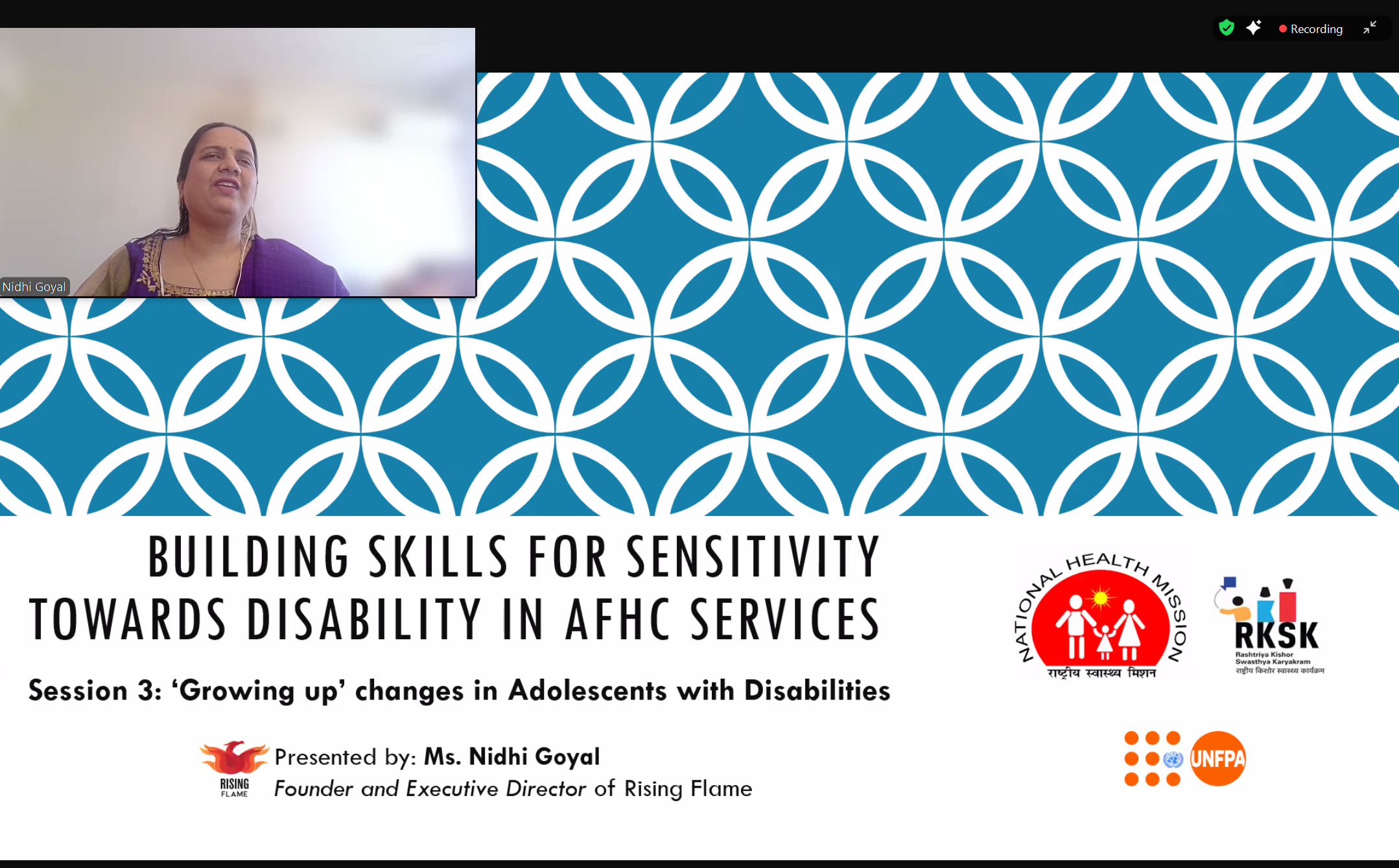
Screenshot of a Zoom webinar with a presentation displayed. A small window on the top left displays Nidhi Goyal on camera. Her background is blurred, she is wearing a purple suit with her hair pulled back. She is speaking. The presentation has the title of the session on it: "Building Skills for Sensitivity Towards Disability in AFHC Services. Session 3: Growing Up’ Changes in Adolescents with Disabilities. Presented by Ms. Nidhi Goyal. Founder and Executive Director of Rising Flame."


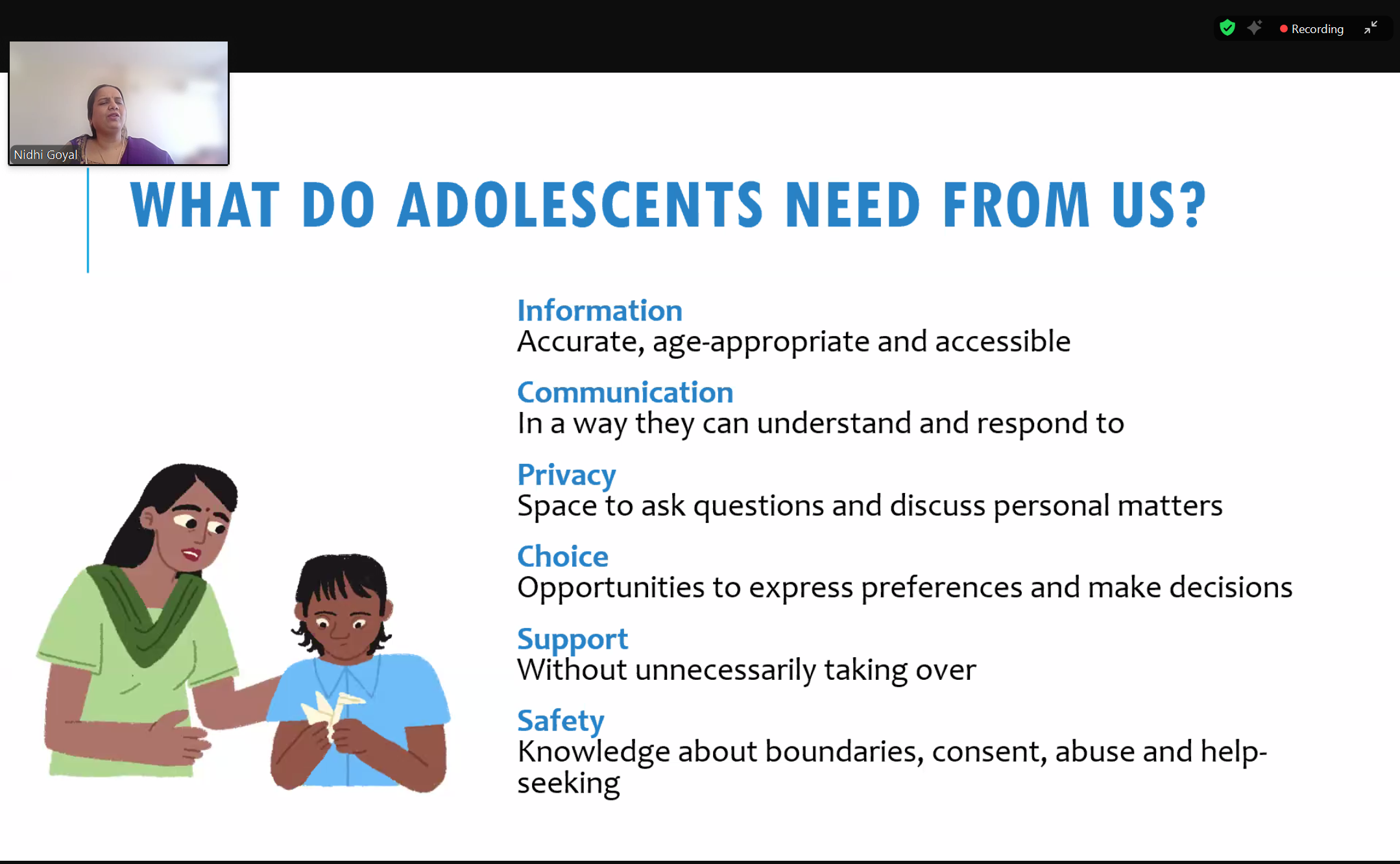
Screenshot of a Zoom webinar with a presentation displayed. A small window on the top left displays Nidhi Goyal on camera. Her background is blurred, she is wearing a purple suit with her hair pulled back. She is speaking. The presentation has the following text on it: "What do adolescents need from us? Information​: Accurate, age-appropriate and accessible. Communication​: In a way they can understand and respond to. Privacy​: Space to ask questions and discuss personal matters​. Choice​: Opportunities to express preferences and make decisions​. Support: Without unnecessarily taking over​. Safety​: Knowledge about boundaries, consent, abuse and help-seeking​."